Teacher's AI Toolkit for Higher Education
A toolkit to help teachers in higher education make good decisions about using AI in their own teaching and in how they ask students to use it.
This toolkit helps teachers in higher education make good decisions about using AI, both in their own teaching and in how they ask students to use it. It is not a rule-book. It offers a way of thinking the decisions through, some pedagogical and even philosophical questions worth sitting with, and practical examples of using AI to teach better and help students learn more. Whether and how to use AI in any given course remains the teacher's decision, within the institution's policies.
For the sake of clarity, AI in this toolkit refers to general-purpose large language models (LLMs).
Contents
How does AI change teaching and learning?
It is tempting to say AI changes everything we know about learning. It does not: the way humans learn is still the same. We have seen this pattern before, for example when calculators arrived. At first we were frightened, but eventually we were comfortable letting the calculator run the mechanical arithmetic while we still understood the problem. With AI, though, the situation is a little different: the risk of outsourcing your thinking, and therefore your learning, is large. If you let AI do all the hard tasks, you remove the friction that is an important mechanic in learning.
Even so, we should not treat AI as merely a threat, as though it were only about outsourced thinking. It can also augment your thinking and learning by sparring with you and explaining things to you, and it can free you from mechanical tasks so that you can focus on what really matters. The key is to recognize where and why to use AI in teaching and learning, and to stay aware of what you are letting it do to your thinking and learning: when you are offloading cognitive effort, and when you are outsourcing it.
The rest of this toolkit builds on constructive alignment (Biggs, 1999; Biggs and Tang, 2007), a well-established framework, and offers concrete moves and worked examples. A short library of teaching scenarios follows and is designed to grow over time.
Before the design framework, a short practical foundation. Many universities now provide basic AI training and guidelines for teachers, so this section stays brief: it covers only what a teacher most needs at hand when using AI for the work in this toolkit, what AI is good and bad at, how to ask it for what you want, and how to check what it gives back.
Working with AI: capabilities, prompting, and verification
What AI is good and bad at
AI is not uniformly capable. Its abilities form what has been called a jagged frontier (Mollick, 2024): it is unexpectedly strong at some tasks and surprisingly weak at others, and the boundary is rarely where intuition places it. It will often handle what you expected to be hard (drafting a rubric, synthesizing three opposing arguments, adapting a case study to a new discipline) and then trip on what you expected to be trivial (keeping to an exact word count, tallying a text's sources, holding a simple constraint steady across a long answer). The practical consequence is that you cannot assume a task is easy or hard for AI just because it would be easy or hard for a person.
Two failure modes matter most for teaching, because both are easy to miss: hallucination is the confident production of plausible but wrong content (invented references, fabricated statistics, events that did not happen), phrased exactly like correct content. Sycophancy is subtler and, in teaching, often more dangerous: the model tends to tell you what you seem to want to hear, agreeing with a flawed premise or reinforcing a shaky understanding rather than challenging it. A student who does not yet know the material cannot catch either failure. Neither can be fully prompted away, so both are managed by verification instead.
Building on this, treat AI as a fast, well-read collaborator who is sometimes wrong without signaling it. It is excellent for first drafts, alternatives, explanations, and things to react to, but unreliable as a final authority on anything specific. The rest of this section is about getting more of the first and guarding against the second.
How to prompt: the CO-STAR prompt framework
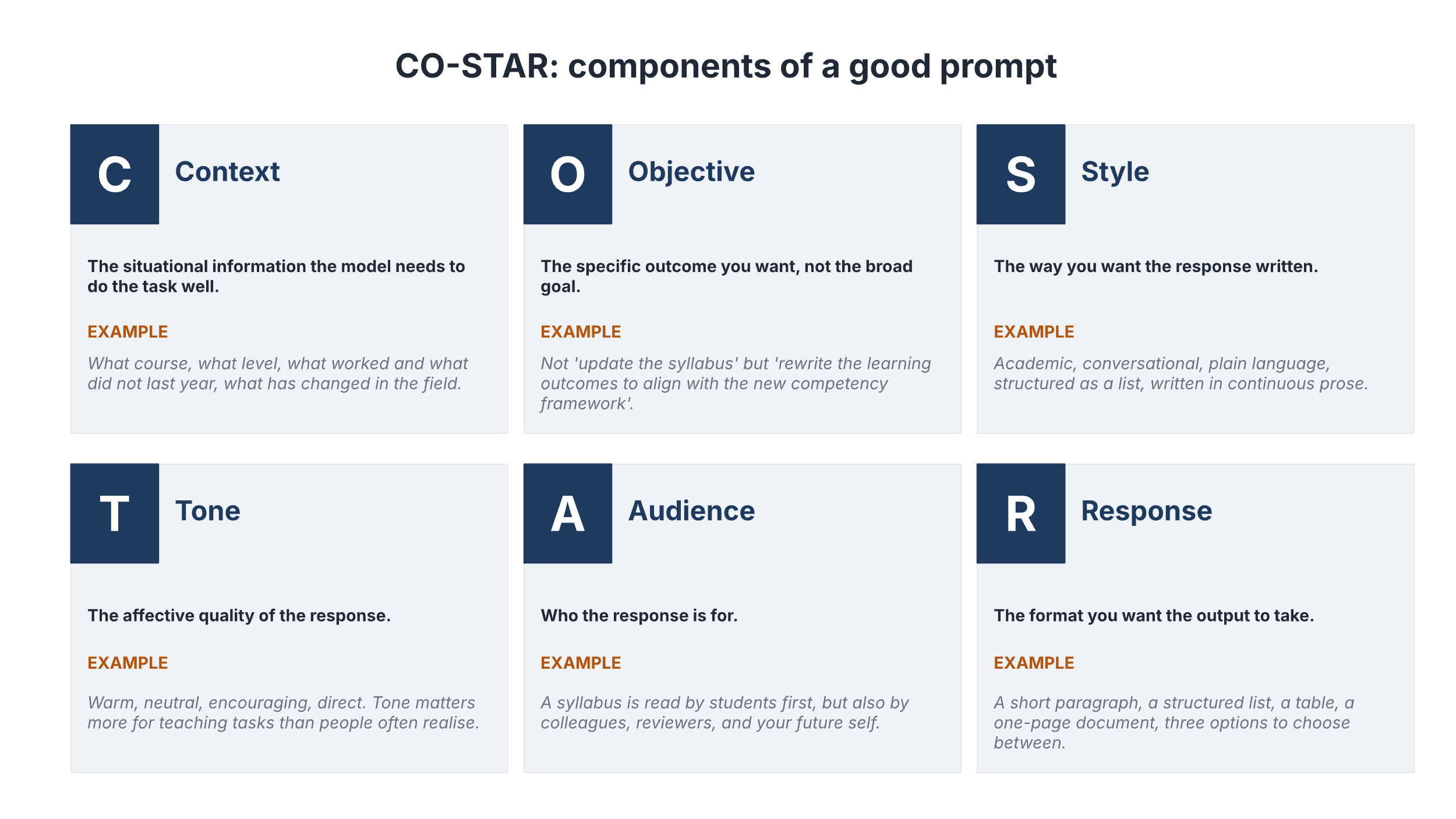
Most disappointing AI output comes from thin, short prompts. A one-line request leaves the model to guess the situation, the audience, and the format, and it guesses average. A useful way to write a fuller prompt is the CO-STAR framework (Teo, 2023; see Figure 1), whose six elements map cleanly onto teaching tasks.
- Context – the situational information the model needs to anchor its answer in your specific situation rather than a generic one: who is involved, what has happened already, and the constraints that apply.
- Objective – the specific outcome you want. A sharp, concrete objective is the biggest single lever on quality; the vaguer it is, the more the model falls back on generic, average output.
- Style – how you want it written, from academic to plain, continuous prose to a list. You can also name a reference text whose voice you want it to match.
- Tone – the affective quality, such as warm, neutral, or direct. Tone changes how a reader receives otherwise identical content.
- Audience – who the response is for. Naming the audience shifts what the model prioritizes and how much background it assumes.
- Response – the format you want, such as a paragraph, a table, or a set of options to choose between. A format constraint stops the model defaulting to its standard medium-length answer.
A CO-STAR prompt in practice (syllabus revision)
Context: I teach a second-year undergraduate Organizational Behavior course of about 60 students. It runs for 6 weeks, with a group project as the main assessment. Last year the project bunched into the final three weeks, students left it too late, and the results were weak; the lectures and readings worked fine.
Objective: Redesign the group project so the work spreads across all 6 weeks. Propose three or four smaller milestones with deadlines, say what each milestone should produce, and keep the total student workload about the same as before.
Style: Plain, concrete language, no pedagogical jargon.
Tone: Practical and collegial.
Audience: Me and the two co-teachers who will run the project, who will review the design before it reaches students.
Response: A week-by-week table showing each milestone, its deadline, and what students submit, then a short note on what changed from last year and why.
You rarely need all six every time – context, a sharp objective, and a response format already outperform most basic short prompts. The example above shows the advantages of the full version: the detail is what stops the model guessing and gets you a draft close to what you would have written yourself.
The conversation is a revision process
The most common mistake is treating prompting as a single act: writing the prompt, taking the output, and then pasting it where it goes. That treats the model as a search engine, when it is closer to a colleague who responds to follow-up. The first output is best understood as a draft. It shows you what the model heard, and where the gap between your intention and its understanding sits. The next turn is where you close that gap: you tell it what to change – cut the length in half, develop the one idea that worked, or rewrite outcomes that still feel generic so they could only belong to this course. The output improves with each turn, and the refined prompt becomes a record of that thinking, one you can save and reuse in a Claude Project or a Custom GPT, so the context you set once serves you many times over.
How to check: verifying what AI gives back
Because of hallucination and sycophancy, the discipline that complements good prompting is verification. Anything specific (names, dates, figures, quotations, citations) needs checking before it reaches students or informs a decision. A simple, teachable routine is SIFT (Caulfield, 2019):
- Stop before accepting or sharing a claim.
- Investigate the source the AI names: does it exist, and does it say what the AI says it does?
- Find better coverage from a source you already trust.
- Trace claims back to their origin rather than to the AI's paraphrase.
SIFT is worth teaching to students as well, since it is exactly the habit that AI use makes essential. The principle is simple: whatever the model produces is yours to verify before you rely on it.
From foundation to design
These fundamentals (what AI can do, how to ask, and how to check) are what make the rest of this toolkit usable. With them in hand, the real question is not which tool to use but how AI fits the design of a course. That is what constructive alignment helps us think through.
1. Constructive alignment
Constructive alignment (Biggs, 1999; Biggs and Tang, 2007) has been the dominant framework for university course design for decades, underpinning the European learning-outcomes reforms and the design of millions of courses (Figure 2). At its heart are three questions every course designer must answer: what should students be able to do, what will help them get there, and how will we know they have? Constructive alignment turns these into three components that must align:
- Intended Learning Outcomes (ILOs) – what students should be able to do by the end, in observable action verbs (analyze, design, evaluate, justify).
- Teaching and Learning Activities (TLAs) – the activities through which students build that understanding.
- Assessment Tasks (ATs) – the tasks that produce evidence the outcomes have been reached.
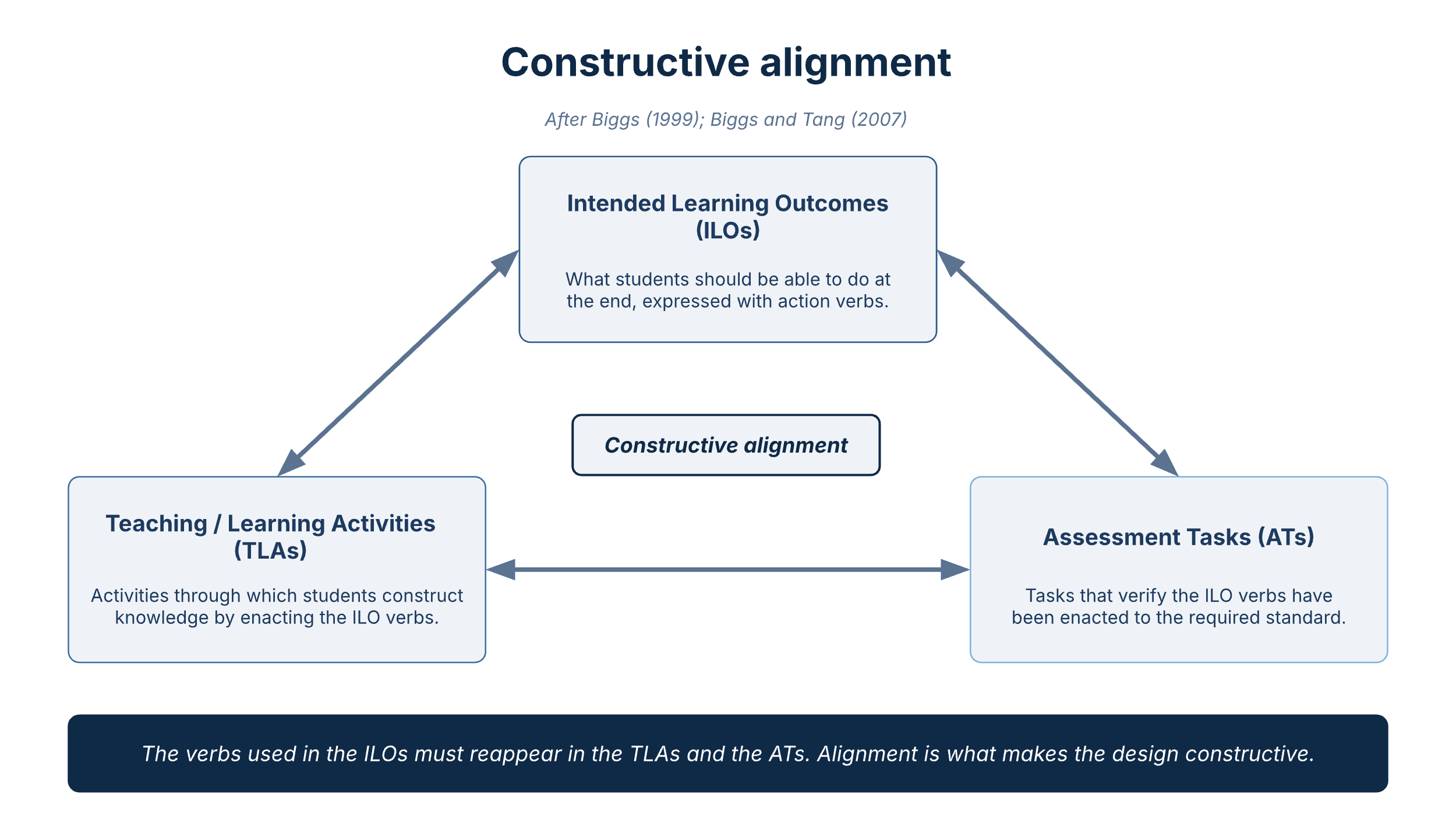
It is constructive because students construct knowledge through what they do, not through what is delivered; it is alignment because the three components must point to the same place. A course whose outcomes promise that students will design but whose assessment only asks them to recall is misaligned, however good each part is alone.
AI affects all three components, but it does not displace the framework. Biggs's questions are still the right ones to ask; what changes is how we answer them. AI makes some long-aspirational pedagogy practical for the first time, but it also demands new caution in other places. One question runs through the whole toolkit: what do we gain, and what do we lose, when we use AI here?
2. Intended learning outcomes
Traditionally, outcomes are written once and apply uniformly: aimed at the average student, supported by activities at the same level, and tested at the same level, with differentiation only at the margins. Yet cohorts are rarely homogeneous (Tomlinson, 2001): a strategy seminar might seat a ten-year consultant next to an undergraduate meeting the subject for the first time, and pitching the course to the middle serves neither well.
What AI lets us do
AI lets a teacher hold the outcomes constant while differentiating the path to them, and, more ambitiously, differentiate the outcomes themselves where a cohort genuinely needs different things.
What makes this practical is a single, ordinary capability: AI can take one piece of material a teacher has already made (an example, an explanation, a problem set, a reading guide) and re-pitch it for a different background or level in seconds. Producing and maintaining several versions of everything used to be what made differentiation prohibitive for one teacher; that is largely the cost AI removes.
Differentiated paths to common outcomes. The same outcome (analyze a strategic decision) can be reached through different activities, examples, and pacing: tailored examples drawn from each student's background, explanations pitched to their prior knowledge, pacing that adapts. The assessed tasks vary while all leading to the same outcome. This is the version most compatible with traditional course design.
Differentiated paths to differentiated outcomes. More ambitiously, AI lets a teacher negotiate genuinely different outcomes for differently prepared students, the consultant extending the material into a new domain, the undergraduate demonstrating the foundations. Both do real work but are not asked to demonstrate the same thing. This raises harder questions about grading and fairness and depends on institutional infrastructure most universities lack; it is best flagged as a possible future direction rather than a present move.
But is differentiating outcomes even necessary?
Often, it is not. An outcome written generously enough (students will be able to analyze a strategic decision) is loose enough that both the consultant and the undergraduate can meet it, at different depths and through different work, without the outcome changing. On this view the differentiation lives in the activities and the evidence, not the outcomes. Narrowly written outcomes force differentiation up to the outcome layer; generously written ones let it happen below – AI lowers the cost either way.
Where this comes from in the literature
Differentiated paths to common outcomes draw on Vygotsky's zone of proximal development (1978), where learning is most productive just beyond what a student can do alone, a target that differs across students, and on Tomlinson's differentiated instruction (2001), which adapts content, process, and product to readiness, interest, and profile. Two points are widely misunderstood: differentiation is not hyper-individualized or chaotic and does not mean more work for stronger students (it rests on ongoing, multi-channel formative assessment); and it centers on student self-selection. AI helps on both counts, making differentiated options feasible to produce and helping students judge which fits.
Applying constructive alignment to outcomes
If outcomes change, activities and assessment must change with them. A course that personalizes outcomes but not activities and assessment falls out of alignment: students are told to reach different ends but do the same work. Push personalization through all three components, or none.
Practical limits
The full version, genuinely different outcomes for different students, needs more than one teacher can build: assessment systems, grading policies, and program designs built for non-uniform outcomes, plus time to design for variation. Most universities lack this, and building it is a slow institutional negotiation, quite apart from whether the most aggressive personalization is even desirable or would erode the shared experience that makes a cohort a cohort. But the institutional ceiling does not limit what a teacher can do now, within current structures.
What personalization can look like in practice, right now
- Tailored examples on demand. Instead of one set of examples, AI produces alternatives adapted to different profiles in minutes: a finance version, an engineering version, an HR version. Same concept, several doorways in – letting students choose their version is itself a form of engagement.
- Pre-class background-knowledge assessment with adaptive follow-up. A short diagnostic before a session points students who know the material toward extension work and those who do not toward foundations; AI can analyze the responses and suggest the follow-up, and the same setup differentiates assignments by level. Emphasize to students that harder material is an extension, not a requirement for a higher grade: a student who works only through the foundations and meets the outcomes still earns full marks. Mistaking differentiated material for a track system is a common misconception to head off in advance.
- An AI tutor configured for the course. A custom assistant shaped around a course (its vocabulary, examples, readings) gives every student a tutor to consult outside class hours, answering routine questions that would otherwise consume office hours.
None of these requires restructuring a course or the infrastructure the ambitious version would need.
3. Teaching and learning activities
If outcomes are the destination, activities are how students get there, and it is where AI's role is most varied. It helps to distinguish activities by who controls them:
- Teacher-led activities. Lectures, demonstrations, structured exercises – the teacher decides, and AI is a preparation tool.
- Peer-controlled activities. Group work, peer review, collaborative projects – the teacher sets conditions; AI can join as an additional participant.
- Self-controlled activities. Independent reading, problem sets, writing, self-study – the student decides, and AI acts as a tutor for solo work.
Teacher-led activities
The least controversial use: the teacher uses AI to design and produce what students encounter (examples adapted to the cohort, cases tied to a recent event, materials at several levels), reviewing and editing so the pedagogical responsibility stays with them. A few reliable patterns: generate first drafts and edit hard; adapt existing material rather than inventing from scratch; use AI deliberately for what it is weak at (counter-arguments, weaknesses); and verify anything specific (names, dates, figures, citations) before it reaches students.
Three patterns for AI-aware assignments
Three design choices make good AI use natural and misuse hard, at the level of how the work is structured.
Process-visible work: when students show their thinking across stages (annotated drafts, in-progress notes, recorded reasoning), the question shifts from "is the product theirs?" to visible evidence of how it was made. AI can now fake a version history (Bowen and Watson, 2024), but the value of process-visible work was never only as proof: it is better learning in its own right, because students think more carefully when they know the teacher will see their reasoning, not just their final answer.
Annotated reading: marking up a text (agreements, confusions, push-back) is hard to fake convincingly, builds reading skills AI does not develop, and is itself the evidence of thinking.
Stage-by-stage decisions about AI: where an assignment unfolds in stages, the teacher decides where AI is welcome (draft first then use AI for feedback, or brainstorm with AI then write alone), and the instructions say what is permitted and why. One way to communicate this is the five-level scale described next.
Communicating AI use to students: the five-level scale
Once AI's role in a task is decided, students must be told, clearly; vague instructions produce vague compliance. A useful tool here is a five-level scale that lets a teacher mark, per task, how much AI use is expected. The scale is adapted from the AI Assessment Scale (Perkins et al., 2024), which describes AI use as a series of levels rather than a simple yes or no. A common wording of the five levels runs:
- AI forbidden; no AI use for the task.
- AI restricted to ideation only; AI may help with brainstorming and planning, but the submitted work is the student's own.
- AI allowed with approval and attribution; AI may be used in agreed ways, disclosed and cited.
- AI allowed with attribution; AI may be used more freely, provided its use is disclosed and cited.
- AI as part of the task; using AI is itself part of what the task assesses.
The levels only communicate a decision the teacher has already made. The real work comes before that: choosing which level fits which task, and why. A complex assignment may sit at different levels for different stages.
Where the scale does not work
A level tells students how much AI is expected, but not how it should be used: drafting versus critiquing, one tool versus another, all sit inside the same level. It does not, on its own, specify the disclosure format, and it does not replace specific written instructions for the task. It is a shared vocabulary and a starting point, not a complete system; used as a substitute for thinking, a level label produces the same compliance theater as any shortcut. The scale's own guidance makes this point directly: the levels are a design tool, and the learning outcome always comes first, so if AI use at a given level would undermine what the task is meant to develop, that is a reason to choose a lower level, not to spread tasks evenly across all five.
Scenario 1Case-based debate on a strategic dilemma
Teaching situation. You are teaching a strategy or organizational behavior course. You want to run a structured debate on a contested business decision (a layoff, a market entry, an ESG trade-off, or similar).
The teaching workflow. Students move through four stages:
- Students are assigned to two groups, one supporting the decision and one opposing it. Sides are assigned, not chosen, because inhabiting a position you did not pick is part of the pedagogy.
- Each group investigates the case, gathers evidence, and develops the strongest possible argument for their assigned position. AI tools, including deep research features, can accelerate this stage by surfacing literature, financial data, industry reports, and stakeholder perspectives that would otherwise take hours to locate.
- Each group creates a game plan for the debate: lines of argument, anticipated counterarguments, and allocation of roles.
- The debate happens in class.
Things to think about.
- Where in the four stages is the actual learning happening? Is that where AI should help, or where it should stay out?
- If AI does the research stage well, what does that change about what students need to do next? Does organizing evidence into an argument become more or less demanding?
- What is the unique value of being assigned a position you did not choose? Does AI help students inhabit an unfamiliar perspective, or shortcut the work of thinking like the other side?
- If students use AI to prepare arguments, are they still learning to argue, or curating AI's arguments?
- Constructive alignment: which component is most under pressure, the outcomes, the activity, or the assessment, and where does AI threaten or support the alignment?
Starter prompts to try and modify.
- Generate three contrasting stakeholder positions on [Company X's decision to Y], with the strongest evidence-based argument for each. Include likely counterarguments.
- Conduct deep research on [decision] from the perspective of [stakeholder group]. Surface the most credible recent sources, identify the strongest argument that side could make, and flag the weakest assumption in their position.
- Act as a Socratic discussion facilitator. I am preparing for a debate on [topic]. Don't give me the answer; ask me questions that strengthen my reasoning.
Scenario 2Generating teaching cases and materials
Teaching situation. You need fresh mini-cases, examples, or illustrative materials. AI can generate these in minutes; the question is what AI-generated material gives you that ready-made cases cannot, and what it requires from you in return.
The teaching workflow. Pick a topic and a type of material, then:
- Generate two or three candidate pieces. Variety matters more than perfection here; you want raw material to react to.
- Critique what AI produced for four things: what is good, what is wrong, what is superficial, and what is plausibly wrong but believable. The last is the most dangerous, because it survives a casual reading and reaches students intact.
- Push AI further: can you customize for your student group, recent events, or local context? Custom output can beat a generic ready-made case.
- Name what the workflow requires from you. Verification, editing, and judgment are part of what the teacher contributes when AI does the production.
Things to think about.
- Can you customize an AI-generated case more deeply than a ready-made one? Probably yes, and that changes the calculus: customization is no longer reserved for textbook authors.
- If a student learns from a plausibly wrong fact, who is responsible? The honest answer is the teacher; AI is a tool, and the teacher decided to use it.
- What is the minimum verification workflow you would commit to before AI-generated material reaches students?
- Constructive alignment: do the materials exercise the verbs in the outcomes, and does their content match what the assessment will measure?
Starter prompts to try and modify.
- Write a 300-word mini-case about a mid-sized B2B company facing a [dilemma]. Include realistic financial details and three discussion questions at different cognitive levels.
- Conduct deep research on [recent development]. Convert the most pedagogically useful aspects into a teaching mini-case for a [course] class, preserving factual accuracy and adding pedagogical structure.
- Take this generic case and adapt it for [student group]. Change the industry context, complexity, and emphasis without losing the core learning point.
Peer-controlled activities
Group work has always been constrained by group composition: the strongest dominate while the weakest disengage. AI can join as a further participant, not replacing peers but taking on roles peers sustain poorly: the patient explainer, the tireless devil's advocate, the consistent reviewer. Students can consult it alongside each other while working problems, rehearse peer-review feedback on it first, or use it as a sparring partner that pushes back without ego in argument-based work.
Scenario 3Writing AI use instructions for students
Teaching situation. Students work in teams on a real client project, analyzing a strategic problem and presenting recommendations. Rather than reopening the question of whether AI should be allowed, the task is to write clear instructions on how to use AI on this assignment.
The teaching workflow. Students need a short written guide telling them four things:
- Where AI is required, permitted, or off-limits in their workflow. This can vary across stages: a client project might permit broad AI use at background research, narrow it at analysis, and forbid it at the final synthesis, where the team's own judgment is what the client is paying for.
- How to use AI well, meaning what good prompting and critical use look like here. Unspecific guidance invites unspecific work.
- How to document or disclose their AI use. The disclosure format communicates what you value, and writing it is part of the learning.
- What you will be looking at when assessing, and how the assessment distinguishes the team's contribution from the AI's.
Things to think about.
- What is the original learning objective of a client project? Which parts does AI threaten, and which does it support? The same tool can be a threat at one stage and an asset at another.
- If you forbid AI entirely, are you training students for a workplace that no longer exists? If you permit it broadly, what unique value does the project still deliver, and how does the design make that visible?
- Where does AI add genuine speed without cost (background research, benchmarking), and where does it speed up the wrong things (the synthesis where the team's judgment is the point)?
- Constructive alignment check: do the instructions keep outcomes, activities, and assessment aligned? If a stage is meant to be AI-free but the assessment could still be passed with AI-generated work, the instructions are not enough.
Starter prompts to try and modify.
- Analyze [Company X]'s competitive position using Porter's Five Forces. Identify the two most strategically significant findings and explain why.
- Conduct deep research on [Company X]'s industry and competitors' recent moves over the past twelve months. Summarize the three strategic challenges a consulting team should take most seriously.
- I'm working on a consulting recommendation for [client]. Challenge my assumptions and find weaknesses in this argument: [paste argument].
Self-controlled activities
This layer holds the largest gains and the largest risks. On the gain side, AI gives every student the kind of tutor once reserved for the wealthy, available at any hour and, once set up for the course, shaped to its material. On the risk side, there are four failure modes:
- Sycophancy. The AI tells the student what they want to hear, reinforcing wrong understanding under a plausible, supportive surface.
- Hallucination. Confident, plausible, invented content that a student new to the material cannot catch.
- Outsourcing. The student stops doing the cognitive work; the activity continues but the learning stops.
- Self-deception. An engaging conversation feels like learning without producing durable understanding.
Self-directed AI works under the same conditions as any self-directed learning: enough metacognitive maturity for the student to notice whether they are actually learning, enough structure in the task to signal when they are not, and a well-configured tool whose mistakes can be caught rather than taken on trust.
Five practical adjustments that lower the temptation to misuse AI
Much of the temptation to misuse AI comes from conditions that always mattered and that AI now stresses further. A student who feels there is room to think, and time to do it, rarely needs to hand the work to a machine; a student who feels cornered often does. Building on Bowen and Watson (2024), five adjustments to how a course is run lower the pressure that pushes students toward misuse. None of them is about AI specifically, which is precisely the point: they are good teaching that happens to make AI misuse less tempting.
Frequent low-stakes assessment. When a grade rests on a single high-stakes submission, the incentive to shortcut it is enormous, and a student who falls behind has everything riding on one moment. Spreading assessment across many smaller, lower-stakes tasks (formative instead of summative grading) lowers the cost of any one of them and gives struggling students a way back rather than a cliff edge. The stakes that drive panic are reduced, and with them the temptation.
In-class active learning. Thinking that happens in the room, in discussion, in problem-solving, in writing done on the spot, is visible as it occurs and cannot be retroactively produced by AI the night before. The more of a course's intellectual work happens where the teacher can see it, the less rests on artifacts a student produces alone and unobserved. This does not require abandoning out-of-class work; it means anchoring the course in moments where thinking is witnessed.
Reasonable workloads. Overload is one of the most reliable drivers of academic shortcutting. A student facing more than can honestly be done in the time available will find a way to compress it, and AI is now the easiest way. Calibrating the workload to what the credit hours actually allow removes the overload that turns AI into an escape hatch, and it improves the learning of students who were never going to cut corners anyway.
Flexibility. Much misuse is not premeditated but panic-driven: a deadline arrives, the work is not done, and the student reaches for the fastest exit. An occasional penalty-free extension, or a built-in policy that allows a student to defer a deadline a small number of times, defuses that panic.
Modeling integrity. If teachers use AI in their own work but never say so, students infer that the honest thing is to hide it. If teachers disclose their own AI use openly, in a syllabus, in lecture preparation, in feedback, students gain a model of what responsible, transparent use looks like. Integrity is learned partly by example, and the teacher is the most visible example in the room.
Taken together, these adjustments describe a difference in kind between two courses. An overstuffed, high-stakes, rigid course produces students who cut corners regardless of the tools available to them, because the pressure to do so is built into the design. A paced, open, humane course produces students who reach for AI as a tool rather than an escape, because the conditions that make misuse tempting have been largely removed.
Scenario 4Creating assignments with AI
Teaching situation. You need to create assignments, multiple-choice questions, essay prompts, problem sets, or exam questions, and want to use AI to accelerate the work while producing items that genuinely measure what you care about.
The teaching workflow. Pick one assignment type and a topic, then:
- Generate a first batch of items. Quantity is fine here; the goal is something concrete to react to.
- Critique for alignment with outcomes, difficulty, item quality, hidden assumptions, and the most dangerous category: items plausibly worded but flawed in ways students will not catch.
- Iterate the prompt. The first generation is a draft; sharper instructions produce substantially better second and third generations.
- Decide the verification and editing workflow before any item reaches students. Without it, AI-generated items can mis-teach an entire cohort.
Things to think about.
- AI is excellent at items that sound good. Sounding good and measuring well differ. How do you tell whether an item measures what you intend?
- If AI generates fifty items in five minutes, does their value rise, fall, or hold? Volume helps for low-stakes practice, but volume without verification creates problems faster than it solves them.
- What goes wrong with unreviewed items? Low-stakes: students learn slightly the wrong thing. High-stakes: the same error raises validity and fairness questions the institution must answer.
- Constructive alignment check: do the items ask for the verbs in the outcomes, or fall back to recall and recognition that AI is best at generating?
Starter prompts to try and modify.
- Generate five multiple-choice questions on [topic] at the apply level of Bloom's taxonomy. Four options each, one correct and three plausibly wrong; indicate the correct one and explain the reasoning.
- Conduct deep research on [topic] focusing on common misconceptions. Use the findings to generate five short-answer items that target the misconceptions and require reasoning from current evidence.
- Write three essay prompts on [topic] that require students to take a position and defend it with evidence, and that are hard to answer well using AI alone.
Scenario 5Admin and course materials (teacher-side AI use)
Teaching situation. You have preparation work AI could help with: updating a syllabus, refreshing a reading list, summarizing materials into a study guide, generating content from old slides, drafting feedback templates. The work is high-volume and low-stakes per item, and the verification cost is bounded because you are the subject-matter expert.
The teaching workflow. Pick one task and try it for real:
- Updating a syllabus or a section of one.
- Refreshing or expanding a reading list, with deep research doing some of the surfacing.
- Generating new content (slides, summaries, study guides) from existing materials.
- Drafting feedback templates or rubric language.
- The discipline is the same across all of them: generate a first draft quickly, edit aggressively, and verify what is verifiable.
Things to think about.
- If AI accelerates this work, what should you do with the time saved: better teaching, or more of the same? The gains compound only if the time is reinvested in what AI cannot do.
- AI is good at plausible course materials. Plausible is not the same as aligned with your course. How do you tell AI-generated coherence from genuine alignment with the course you are teaching?
- How does your own teacher-side AI use connect to the disclosure you ask of students? If you could not describe your own use to a curious student, that is a signal.
Starter prompts to try and modify.
- Here is my current syllabus for [course]. Suggest three ways to update [section] for next semester, given recent developments in [field].
- Conduct deep research on recent scholarly and industry sources on [topic] from the past twelve months. Suggest five readings to refresh my reading list, with a brief justification for each.
- Critique these learning outcomes against Bloom's taxonomy. Which are too low-order for a [graduate or undergraduate] course?
Applying constructive alignment to activities
Across all three layers the framework asks one question: do the activities exercise the verbs in the outcomes? An outcome that promises students will analyze needs activities in which they actually analyze; if the AI is doing the verb (here, analyzing), the alignment is broken.
4. Assessment tasks
Assessment is a learning situation
Assessment is easily seen as the verdict after learning, an exit gate to a grade. But it is also itself a learning situation: the student consolidates understanding and makes reasoning visible, and the teacher encounters, for the only time in any depth, how this student thinks. Under the verdict view the AI question is technical (can AI grade reliably?); under the learning-situation view it is harder: if AI grades the work, what happens to the encounter the assessment was meant to provide?
Two distinct registers
Two very different uses must be kept apart. First, teachers use AI to design assessment (rubrics, draft items, or a sparring partner in design), and the student never meets the AI in the assessment itself. Second, AI assesses student work, grading and scoring in place of the teacher's judgment. The first is productive; the second removes the encounter assessment exists to provide, and general-purpose tools such as ChatGPT or Claude were not built to grade student work. Feeding student work into one to produce a grade is a pedagogical mistake, and it also runs against the direction of European regulation, which treats AI systems used to evaluate learning outcomes as high-risk (EU AI Act, Regulation (EU) 2024/1689). The practical point for teachers is simple: use AI to help design assessment, not to mark student work.
What teacher-side AI use looks like in practice
The productive register is teachers using AI to design better assessment. Building rubrics with AI as a thinking partner: it surfaces dimensions and stress-tests descriptors, while the judgment stays yours. Generating draft items at speed for critique: does each item measure what it claims, is difficulty calibrated, are distractors fair? Thinking through design: using AI as a first-reaction colleague when redesigning an assessment students can now complete with AI. In each case the AI accelerates thinking that remains the teacher's.
Scenario 6Building an AI-aware rubric
Teaching situation. You are redesigning an assessment for a course you have taught for years. Students now use AI, and the existing rubric rewards qualities AI can produce on demand while giving no credit for the qualities that distinguish the thinking you want to develop. You need a new rubric.
The teaching workflow. Four stages:
- Articulate, in your own words, what you most want students to do that AI cannot do well. Be specific; "critical thinking" is not specific.
- Use AI as a sparring partner: ask it to argue against your list, propose alternatives, and name capabilities it is weak at that you have not included.
- Draft descriptors at three or four levels for each dimension and have AI test them: are they observable, distinguishable, and would two markers reach similar judgments?
- Iterate until the rubric measures qualities you can defend, in language students can act on.
Things to think about.
- What does AI do well in writing, reasoning, and analysis, and what does it still do poorly? Which does your rubric reward? Many existing rubrics reward exactly what AI is best at.
- What aspects of student thinking are visible only through process, not product, and how might the rubric ask students to make those visible?
- If two students submit similar work, one having leaned heavily on AI, can the rubric tell them apart on what matters? If not, it is not measuring what the assessment was meant to measure.
- Constructive alignment check: do the criteria align with the outcome verbs? An outcome that says analyze needs a rubric that scores the quality of analysis, not the quality of writing about it.
Starter prompts to try and modify.
- I am revising a rubric for [assignment] in a [level] course. It rewards [qualities]. Given that students now have AI, which are no longer good signals of capability, and what should I measure instead?
- Argue against these rubric dimensions. What are they failing to capture, and what might they reward that I would not, on reflection, want to reward?
- I want to assess [capability]. Help me write three descriptors at developing, competent, and excellent, using observable language.
Live evaluation, formative assessment, and active sparring
AI makes practical a long-aspirational kind of assessment: live, formative evaluation during learning rather than after it. A student can ask an AI tutor to find weaknesses in a draft, rehearse an oral defense against an AI examiner, or locate the step where their reasoning breaks. The AI is a sparring partner, not the assessor: the work arriving at the teacher's desk is more iterated and more reflective. This blurs the formative and summative line. Some courses benefit as the final assessment becomes the culmination of a dialogue; high-stakes, certifying courses will keep the sharp line. The framework asks the teacher to be deliberate about which kind of course they are designing.
Sparring conversations as assessable evidence
The sparring conversations themselves can become assessable evidence, disclosed transparently, in three forms of rising ambition. In the first, the conversation is submitted alongside the product as visible process, showing how the student worked but not graded on its own; this adds the least new evidence. In the second, it becomes part of the rubric, scoring the quality of the student's engagement with AI as evidence of AI literacy; this rewards the metacognitive work that literacy requires. In the third, the conversation is the assessment, the dialogue itself the artifact graded; this is the most powerful, but it raises real questions about whose work is being judged. Any such design needs care about disclosure and about the line between the student's work and the AI's.
Disclosure as a part of assessment
If AI is permitted, disclosure of how it was used becomes part of what is assessed, and it is usually undertreated: a checkbox, a sentence, a paragraph no one reads. The design question is not which format minimizes burden, but which produces the most useful evidence of AI literacy.
What weak disclosure looks like
Three disclosure formats are common, and each falls short in its own way. The submission checkbox ("I used AI: yes / no") distinguishes nothing. The single-sentence acknowledgement ("I used Claude for the introduction") is compliance rather than reflection. The statement that names tools and purposes describes what was used rather than how the student thought. Better formats need not be long, but they ask the student to identify a real decision: a point where AI suggested one thing and they chose another, or where they caught something it missed.
What good disclosure looks like
Good disclosure answers four implicit questions: what did you use, what did you ask it to do, what did it contribute, and where did your judgment diverge from it? The fourth is what separates disclosure from acknowledgement. This also works as reflection for the student: how did I use AI, and did I use it well?
During the preparation of this learning diary, I used two AI tools. Claude acted as a thinking partner and drafting assistant. Consensus.app was used to find peer-reviewed sources on group dynamics in higher education.
My workflow had three phases. First, I drafted unstructured notes without AI. Second, I used Consensus.app to locate three peer-reviewed sources, which I read in full before deciding which to cite. Third, I worked iteratively with Claude to structure my notes into prose and integrate the sources. The central argument, that group projects fail more often through unclear role allocation than unequal effort, emerged from extended dialogue with Claude.
Throughout, I made all substantive analytical judgments, verified every citation against the original source, corrected errors in AI-generated drafts, and decided what to keep, cut, and rephrase. I take full responsibility for the content of this diary entry.
At roughly 160 words this tells the teacher more than any checkbox. It does not catalog every prompt or attach transcripts; it names the substantive moments of AI use and where the student's judgment intervened. The format is reflective, and writing it is itself learning.
Teachers should disclose too
If students must disclose, so should teachers, less for fairness than to model the practice. A student who has only seen disclosure as compliance theater will not produce thoughtful disclosure; one who has seen a teacher disclose AI use openly (syllabus drafts, lecture prep, feedback) has a working model. It need not be elaborate: a line in the syllabus, a sentence on a feedback document.
Disclosure and the regulatory direction
Disclosure is also becoming a professional norm. Research publishing, journalism, and professional contexts increasingly expect people to declare when AI was substantially involved in producing work, and European regulation is moving the same way. Building robust disclosure into student work now prepares students for an environment where it is expected, a rare case where the pedagogically useful and the professionally required point the same way.
Applying constructive alignment to assessment
The framework asks of assessment what it asks of activities: do the tasks require the student to demonstrate the verbs in the outcomes? An assessment whose evidence AI could produce is not measuring what the outcome promised. If the AI could produce the evidence, the alignment is broken.
Closing: the framework as a habit of mind
The framework that has guided good university teaching for decades is still the right one with AI in the room, only more demanding and, in places, more achievable. Biggs's three questions have not changed; what AI changes is how we answer them. If teachers take one thing from this toolkit, let it be those questions, held as a habit of mind: what should students be able to do, what will help them get there, and how will we know they have? And alongside them, the question this toolkit adds: what do we gain, and what do we lose, when we use AI here?
Acknowledgements
I thank the Entrepreneurship Unit of the Department of Management Studies at Aalto University for supporting my work on this toolkit. Special thanks to Sanna-Katja Parikka, Specialist at Aalto University Teacher Services, for excellent comments on a draft of this toolkit.
AI Disclaimer
This toolkit was written with the assistance of Anthropic's Claude Opus 4.8. The author used it as a drafting and thinking partner, working from the author's own notes, outlines, and earlier drafts: turning that material into prose to revise, testing arguments, and suggesting phrasing. All pedagogical claims, the framework, the argument, the examples, and the final wording are the author's own, and every source was verified against the original. The author takes full responsibility for the content.
References
Biggs, J. (1999). Teaching for Quality Learning at University. Open University Press.
Biggs, J., and Tang, C. (2007). Teaching for Quality Learning at University (3rd ed.). Open University Press.
Bowen, J. A., and Watson, C. E. (2024). Teaching with AI: A Practical Guide to a New Era of Human Learning. Johns Hopkins University Press.
Caulfield, M. (2019). SIFT (The Four Moves). Hapgood. https://hapgood.us/2019/06/19/sift-the-four-moves/
Mollick, E. (2024). Co-Intelligence: Living and Working with AI. Portfolio.
Perkins, M., Furze, L., Roe, J., and MacVaugh, J. (2024). The Artificial Intelligence Assessment Scale (AIAS): A framework for ethical integration of generative AI in educational assessment. Journal of University Teaching and Learning Practice, 21(6). https://doi.org/10.53761/q3azde36
Regulation (EU) 2024/1689 of the European Parliament and of the Council of 13 June 2024 laying down harmonised rules on artificial intelligence (Artificial Intelligence Act). Official Journal of the European Union. https://eur-lex.europa.eu/eli/reg/2024/1689/oj
Teo, S. (2023). How I Won Singapore's GPT-4 Prompt Engineering Competition. Towards Data Science. https://towardsdatascience.com/how-i-won-singapores-gpt-4-prompt-engineering-competition-34c195a93d41
Tomlinson, C. A. (2001). How to Differentiate Instruction in Mixed-Ability Classrooms (2nd ed.). ASCD.
Vygotsky, L. S. (1978). Mind in Society: The Development of Higher Psychological Processes. Harvard University Press.